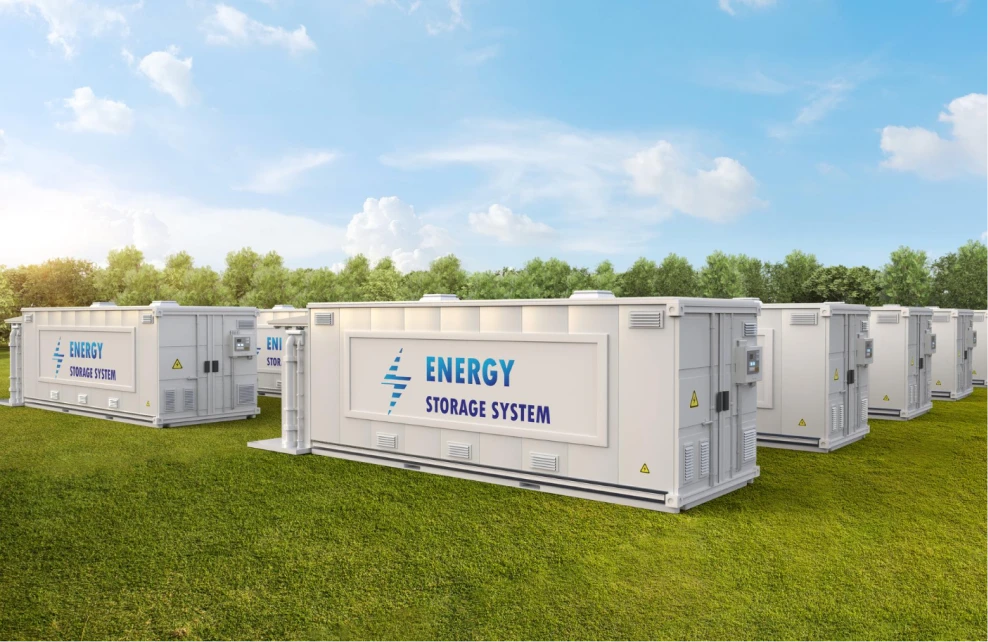
Atlas storage grid
Atlas Grid Partners came to us with a four-hour duration already assumed and a site already optioned. Our first piece of work was to test the assumption, because the wrong duration is not recoverable once the cells are ordered.
Testing the duration
We modeled three years of settlement data across one, two and four-hour configurations. Four hours won, but not for the reason the original business case gave: the arbitrage spread alone did not justify the extra energy, and the capacity market obligation did. That distinction mattered, because a capacity obligation constrains how aggressively the asset can be dispatched on a summer afternoon.
The final configuration carries a firm capacity commitment on the top two hours of energy and trades the remainder.
Design decisions that shaped the site
- Cabinet spacing and deflagration venting designed to the applicable fire code, agreed with the county fire marshal before the layout was fixed
- Thermal management sized for a 47°C design day, with auxiliary load accounted for in the round-trip efficiency figure
- Augmentation bays poured and cabled at construction, with capacity reserved for two additions across twenty years
- A cycling envelope written into the warranty that matches the dispatch strategy rather than a supplier default
Round-trip efficiency is quoted at the cells and paid at the meter. In a desert climate the difference is about three percent, and it belongs in the model.
Operating it
The optimizer bids into energy, regulation and reserve markets simultaneously, respecting the warranty envelope and the capacity obligation as hard constraints. It is retuned quarterly, and was re-tuned twice in the first year after market rule changes.
Year one availability was 99.2 percent against a 98 percent contractual target, and measured degradation tracked the supplier’s curve within half a percentage point.
Storage that earns from
three markets at once
- Revenue stacking rules that changed twice during development
- Fire code adopted locally six months after the layout was fixed
- Augmentation obligations over a fifteen-year contract with uncertain degradation
Nineteen months of a build that mostly looks like cabling